Author: Angelina Soul

  • The doorless MINI Moke is reborn with MINI Beachcomber concept

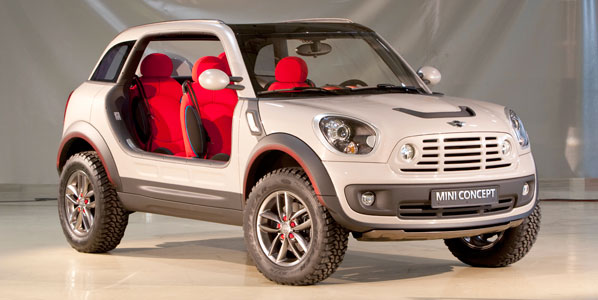
    Mini Beachcomber concept car

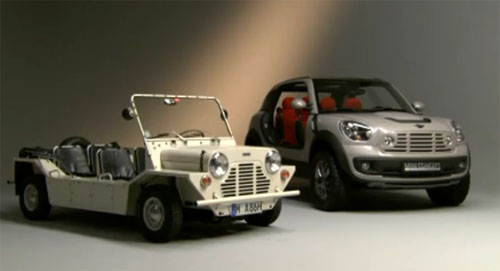
    When look at MINI Beachcomber concept, it is very obvious that it has the characteristic of the 1960’s Mini Moke. The front slotted grill, the headlights, signal lights, hang-over side-mirror, and the overall feeling. The Beachcomber concept is like a re-imagined design for the four-seater, roof-less, and open body car.

    classic and new Mini Moke

    Sir Alec Issigonis was smoking when he designed the first Mini car. That is the reason why the classic Mini has an ashtray in the middle of the dashboard. (more…)

  • Cost to own a car vs. Cost to take taxi

    Most of the people who depend on public transport in their daily life may think about getting a car for their own. Anyone can purchase a cheap car with low maintenance cost, low monthly car payment, as well as low cost car insurance. However, does one really need an own car when the public transport is so convenience at such low cost? Here we did a calculation based on a case study in Thailand.

    In Thailand, the taxi is 35 baht once you get on it, every km after the first km is charged 10 baht accordingly. Let’s say you are going to travel 10 km from home to work everyday, it will cost 125 baht one day, and return will be 250 baht. In a month, we roughly work 22 days, the total cost of using taxi to work will be 22 x 250 baht = 5500 baht a month.

    So, what about getting one cheap new car for 508,500 baht? Now we do a calculation if you get a Honda Brio for work. Honda Brio gives 47 mpg, which is roughly 19.8 km per liter of petrol. A liter of petrol cost 34 baht and the cost to travel 20 km a day in a Honda Brio will be (34/19.8) * 20 = 34.34 baht a day. In 22 work days, it will be 686.8 baht. Other than the petrol, there is a monthly car installment of 9746.25 baht. The total cost for a month is now 10,433 baht. So, owning a car may anytime cost you double compared to using taxi for work.

    The true cost to own the car in 5 years time

    In long term, the calculation will be different compared to what we showed above. There is something else is excluded, the value of the car. If you spend 5500 baht a month for public transport to go for work, in 5 years it will be 330,000 baht. You get nothing because the money you paid goes for the service. Well, you have someone drive you to work.

    On the other hand, if you bought a Honda Brio 5-year ago, now you can probably sell it for 300,000 baht. In 5-year time, you paid a total of 584,775 baht for the car price including car loan interest. The cost for petrol in 5 years is 686.8 * 60 = 41,208 baht. The total cost to use the car for work in 5 years without including the maintenance fee will be 625,983 – 300,000 = 325,983 baht.

    Here is the conclusion of having an own car to go for work and using taxi to go for wok.

    Using car to go for work

    • Pros to own a car: Flexible in time, convenience, and can use the car on weekend for other purposes.
    • Cons to own a car: Extra monthly car payment compared to taxi, having extra cost like car insurance, car park fee, car maintenance, and some intangible cost like car wash as well as anti-theft accessories.
    • True cost to own the car over 5 years: 325,983 baht excluded car insurance and maintenance cost.

    Using taxi to work

    • Pros to use taxi: Just sit and relax in the car and need no tired to drive alone. Taxis are almost everywhere in the town.
    • Cons to use car: Extra cost may occur during weekend when you are going to somewhere else.
    • True cost to use taxi over 5 years: 330,000 baht excluded extra cost during other day.

    From the comparison we made here, the cost to own a car and cost to use taxi to go for work is more or less the same. The only different is that owning a car will have higher cost for every month. It is up to individual and which way you prefer. What will be your choice?

  • Honda Civic: It still smells new after runs for one hundred thousand km in five years

    Honda Civic front view

    Thanks to Ashley who invited us to check on her car, here we got a chance to write a detail used car reviews on her 2007 Honda Civic. Ashley bought the Honda Civic back in February 2007. It is just about a year after the eighth generation of the Civic has been introduced. The model year is 2007 and it is an Asian model which also known as Civic FD.

    The reason why Ashley invited us to review on her car is because the mileage is going to hit 99999 km today. And yes, we are the lucky one who rides in the car with her from 99999 km to 100000 km. We drive the car up hill, down hill and also try some corners with higher speed. We also test the car at speedway up to 170 km/h and the result is really impressive. The car feels stable at 165 km/h and started to feel a little “windy” when the speed hit 170 km/h. Boy, don’t try this at normal way.

    Honda Civic interior dashboard

    How the car was taken care? The car we are reviewing is owned by a single lady at 30 years old. She bought the car when she was 26 years old. 100,000 km for 5 years is quite an average based on our study. Each year runs 20,000 km is somehow average for a car that travel roughly 50 km a day. The owner maintains the car follow the basic car maintenance schedule as suggested in the owner’s manual. Engine oil get changed every 5,000 to 10,000 depending on the oil grade. Brake fluid, auto transmission fluid, and oil filter was changed on time too. According to the owner, spark plug only changed twice since new and the brake pad was replaced when the car hit 70,000 km. Four tires were replaced when 80,000 km when the thread almost finish. We noticed that the only thing didn’t change on time is the air filter. It is dirty and not really in good condition. The car also went to car wash every two weeks and interior gets polished every three months with cheap polish kits purchased from Tesco.

    Total maintenance cost over ~5 years

    For the first few times, Ashley brought the car back to Honda for maintenance and services because it is free and under warranty. After that she feels it is unnecessary to have a nice café to sit while waiting for the car so she brought to a trusted mechanic for cheaper labor cost. This is the rough estimation of what she has spent for the car over ~5 years.

    • Engine oil, oil filter, and services: RM220 x 10 times = RM2,200. Each time for 10,000 km.
    • Car Tires: RM1,200 for four
    • Spark plug: RM60
    • Transmission fluid: RM80
    • Brake Fluid: RM50
    • Air-cond fan and AC gas: RM380
    • Total: RM3,970. The amount is really amazing.

    Update: At the ninth years, the owner, Ashley contacted us saying the car has reached 117,000 km (72,700 miles) and she has replaced the engine motor mount.

    Honda Civic side view

    What is good about this car? It tastes like a new car. The 1.8-liter 16 valve chain-driven SOHC i-VTEC engine gives the maximum 140 hp @ 6,300 rpm and maximum torque 174 Nm @ 4,300 rpm. As we mentioned above, the car is still stable at 160 km/h after putting 100,000 km on it. Cornering, up hill, and braking is pretty good too. The 1.8-liter has enough power for us although there are rumors said that it is under power. May be the rumors were compared to the 2.0S model.

    What isn’t so good about this car? The color of the rubber surrounding the car window at four doors is faded and need replacement. It has never been changed before. According to the owner, the air-condition start giving problems when the car runs 80,000 km. The air-condition fan was spoilt and it was replaced. At the moment we test drive the car, the AC pulley is seems not in good condition too. It causes the AC not cold enough when the car stuck in traffic jam.

    What about the look? As for the exterior, the car still looks brand new. The headlights didn’t become yellow like some of the cheap cars do. The rear lights, exterior logo, grill, bumper, and windscreen are still in good condition. For the interior, dashboard did not have any crack although it often park under hot sun. The only thing spoilt is the Honda logo at the steering wheel which is a little odd.

    What about the safety features? The car has a good braking system with ABS assisted. Front is using ventilated disc and rear is using solid disc. It also comes with dual SRS airbags, security alarm system.

    Any extra point for it? Yes the car boot is big enough for few large luggages and the fuel consumption is low.

    Price: There are three models available from Honda, the Civic 1.8S, Civic 1.8S-L, and the hotter model Civic 2.0S. 1.8S is basic model without leather seat from the price of RM114,980, 1.8S-L is RM119,980 and the hotter 2.0S is from RM130,980.

    Honda Civic’s competitor or similar car: Toyota Corolla, Nissan Sylphy, Mazda3, Peugeot 308, Kia Forte, Chevrolet Cruze, Volkswagen Polo, Ford Focus, Mitsubishi Lancer, and Proton Inspira.

    In conclusion, the Honda Civic is definitely still smells as good as new car after almost 5 years of driving with 100,000 km run.

    Honda Civic interior    


  • Kia Ray EV launched: Korean’s first electric car

    The Kia Ray EV has launched today in South Korea. The Kia Ray EV is the first 100% Korean made plug-in electric car that has the sound of petrol engine. The first EV car in Korea had give a promise to their customers that the car is able to travel up to 86 miles (139 km) on a single charge depending on the driving style. A normal charging time is six hours from normal 220V household electric plug. A fast-charge option is also available for the Kia Ray for whoever wants to refill the electricity in just 25 minutes.

    The Kia Ray shares the same production line with the 1.0-liter petrol powered Ray CUV in order to supply to the domestic Koreamarket. This is good because when Kia developing the EV, they can still adopt the characteristic of what a petrol-powered car should has especially the exhaust sound!

    Kia Ray EV dimension

    What about the design? The Kia Gay EV, Opps, sorry, it is the Kia Ray. For us, it did looks a little bit gay with the dimension of 1,595 mm in width x 3,595 mm in length x 1,710 mm in height. The car is design to look just like the petrol-powered Ray. It has a petrol cap just like others but it is the inlet for fast recharge mode. Both front doors have the word “Zero Emissions EV”. With a square design, 14-inch alloy wheels are best for it. There is also an inlet for the normal charging which hide behind the front grill. As for the boot, it can’t fit in an extra large luggage. At most it can only fit in a new shoe boxes.

    What about the interior? The interior is quite beautiful. It has a three round meter in front of driver with beautiful lights. It is spacious for passengers head due to its height.

    Kia Ray EV interior

    What about the performance? Kia Ray EV is a front-wheel drive car powered by a 50kW electric motor. Sounds a little weird because most of the time we will say “powered by a 4-liter V8 engine”, but soon we may have to compare cars with kW. The main battery used in the car is a high-capacity 16.4 kWh lithium ion polymer battery and it is hiding under the rear seat and cabin floor. The battery is also said to have a 10-year life cycle. Let’s review it again in 2021. From zero to hundred, the record is 15.9 seconds and the top speed is 130 km/h (81 mph).

    Whatever the performance is, we always give our full support to EV because of the zero-emmissions. Remember that previous we mentioned that we want a muscle car EV in our world that has everything just like ‘60s muscle cars including the V8 sound? At least the Kia Ray did it with recorded gasoline engine noises. It is an EV with petrol engine sound which not only makes the car lively but also to alert pedestrians.

    What about safety features? The Kia Ray EV has six air-bags, electronic stability features, and downhill assists control.

    Any special features? The car features an EV navigation system which tells the driver the where the closest recharging stations are. This is quite helpful because within few years there won’t be much electric recharging stations. The car features two driving preference, ‘E’ for eco and ‘B’ for brake. ‘B’ is specially design for the car to handle downhill or mountain roads like Touge. The way to open the car door is special, why? For the driver side, both door handles are stick together. The driver door open as usual but the rear is sliding door. On another side, both doors are opened like usual car. This is what makes this car “special” in open.

    Kia Ray EV’s competitor or similar car: Nissan Leaf, BMW MINI E, Citroen C-Zero, Mitsubishi I MiEV, Smart ED, Tango, Tesla Roadster, Chevrolet Volt, and Th!nk City.

    This is the first trial for an EV in South Korea, so don’t expect the Kia Ray EV will reach our country in a short time. South Korea is far from us to travel by an EV.

  • The most viewed car commercial on YouTube in 2011

    It isn’t a viral video that creates millions of viewer over night. It is “The Force” Volkswagen commercial to promote the all-new 2012 Volkswagen Passat. The video featured a kid wearing like Darth Vader and imagine that he has the power of what Darth has. He tries to control everything by his hand to an exercise bike, dog, and his sandwich. All of them were failed.

    He was a little upset until his father came back with the 2012 Volkswagen Passat, he tries to start it, and the car did start! His magic is work now! At the end of the video, the commercial shows that it is the father who pressed on a remote start to start up the engine within the given range. This is a great feature for consumer especially during winter time or cold early morning. You can start the car from home to heat up the car engine before driving it so that time could be saved. For hot day, remote starter can also very useful to start up the car and let the AC cool down the interior before you get in.

    The commercial is only 1 minute long but it has successfully attract more than 45 millions viewer in Youtube and make it to the number 9 in the most viewed YouTube video in 2011. This is really a very creative commercial. It is another achievement for Volkswagen in 2011 after the company slipped into top 47 of the top 100 brands of 2011.