Author: Angelina Soul

  • Fourteen Seater Mini Moke

    Fourteen seater six wheeled Mini Moke

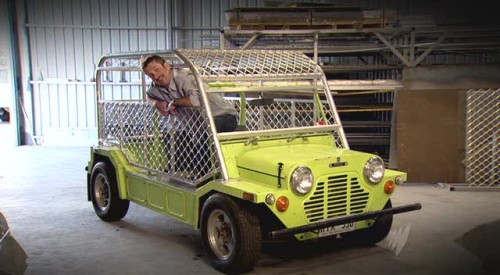
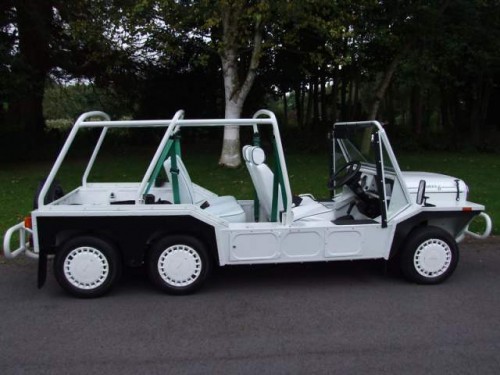
    The legendary BMC Mini Moke is always a fun car to customize due to its unique appearance – roof-less, door-less, and small-size jeep style but impractical to go off-road. Here we spotted a fourteen-seater six-wheeled Mini Moke somewhere on earth. Pictures are provided and it doesn’t really matter where it is right?

    The owner customizes the car with six 13” x 7” Minilite wheels and fourteen yellow plastic seats. The use of plastic seats is to deal with the rain water. Plastic seats are water proof and it is easy to clean if they are wet. The body of the car has been stretched to fit these seats and the length is two times longer than a standard British Moke. We have seen many Moke fans customize their car with cage-style and stretched body with six-wheels, but this yellow fourteen seater moke is the first time and it is one of its kinds. We do not have the details about the engine and powertrain but it could be difficult and slow for a 1300cc engine to pickup fourteen passengers. Slow of fast doesn’t really matter as long as the car bring us to the desire destination, isn’t?

    Customized Mini Moke
    Customized cage-styled Leyland Mini Moke

    If you have taken the time of your life to customize or build a special Mini Moke, please do not hesitate to email us at Malaysiaminilover [AT] gmail [DOT] com. We will feature your car here.

    6 Wheeled Mini Moke

    6 Wheeled Mini Moke

    6 Wheeled Mini Moke
    Six-wheeled Mini Moke

  • Fourth Oldest Surviving Unrestored Mini

    World's oldest surviving unrestored Austin Mini Seven De luxe saloon

    Will you buy a Austin Mini Se7en De Luxe Saloon and have it preserved until today if you have £497 in 1959? It is 53 years of preservation! 99.9% of people won’t do that but someone actually did that. Mr David Gallimore bought a 1959 Austin Mini Se7en De Luxe Saloon (MK1) in 1986 from a Gladys Hobro of Aldwick, Bognor Regis, West Sussex. Gallimore then kept the car in a Chichester barn until recently he is putting the car up for sales. This rusty Austin Mini is covered in dust and chicken feathers and will be auctioned on 30th April at The Royal Airforce Museum in London. It is expected to fetch up to £15,000 which is 30 times more than its original price in 1959.

    Details about the world’s oldest surviving unrestored Mini

    • Car Model: 1959 Austin Mini Se7en De Luxe Saloon
    • Chassis Number: AA2S7/108
    • Engine: A Series 848cc
    • Engine Number: 8AUH-908
    • Original registration plate: XLL 27
    • Body Color: Farina Grey. In 1959, exterior colors available for the Mini are Farina Grey, Tartan Red, and Speedwell Blue.
    • Mileage: 30,041 miles on the doesn’t-actually-work clock meter.
    • Features: MK1 grill, Austin badge, opening front door hinged, rear quarter windows, adjustable front passenger seat.
    • Interior: Original with a white color center speedometer.
    • Little History: The rusty car was the eighth Mini to roll off the production line at Longbridge in Birmingham in May 1959, three months before the car was officially launched on 26th August 1959. It is believed to be the eighth brother of the first Mini 621 AOK that badged a Morris.

    World's oldest surviving unrestored Austin Mini Seven De Luxe Saloon

    What is not original?

    From the pictures everything seems to be original including the glass washer bottle and the dynamo (instead of an alternator) that we seldom see on today’s classic Mini. The only big part that has been replaced is the driver’s door. It is in red color that does not match with the farina grey. Inside, the original carpets is not there. Well, carpet may not be able to survive more than 50 years.

    The engine has not been run for many years and it appeared to be original with rust. Sub-frame, steel hydraulic pipes, cable to open the passenger doors, two pieces windows, and many others are still in original condition.

    World's oldest surviving unrestored Austin Mini Seven De luxe saloon
    Interior of the fourth oldest unrestored Mini: Note that the driver’s door is in red.

    What Else?

    There are three Mini were born earlier than the XLL 27 and all of them have been restored over the years. One is 621 AOK that now lives in the British Heritage Motor Centre Meseum in Warwickshire, and the other two are living in private collectors’ house in Japan. In 1999, the Mini was voted the second most influential car of the 20th century, behind the Ford Model T.

    World's oldest surviving unrestored Austin Mini Seven De luxe saloon
    Images are taken from Car and Classic UK

    Austin Mini XLL 27

    What MalaysiaMiniLover Says?

    It has everything although the mechanism and instruments are simple. The simplest things are often the truest.

    You are buying a hero that save the world from Suez Crisis rather than just buying a small classic car.

    The condition of the car is not roadworthy, but you don’t find one car like this on the road.

    The interior do not carry any modern features such as air conditioning, power windows, or even a car stereo. That’s what we call “Classic”.

    With the budget around £15,000, there are many new cars available in the market such as Toyota Yaris Hybrid and Ford Focus, will you go for these cars rather than the one and only XLL 27? As a Mini lover, we will die for this fourth oldest surviving unrestored Mini.

    After more than half century, the Mini is still one of the most popular and successful British car ever built.

    What will you do if you stand a chance to own this car?

    1. Buy it, let it untouched and continue to keep it in garage.
    2. Buy it, clean it up, and continue to keep it in a better garage for another 50 years.
    3. Buy it and restore it to its former glory.
    4. Buy it, spend thousands of pounds to restore it into a new look to drive up its price.

    More Related Pictures (From eBay)

    1959 Austin Mini Se7en De Luxe Saloon

    1959 Austin Mini Se7en De Luxe Saloon

    1959 Austin Mini Se7en De Luxe Saloon

    1959 Austin Mini Se7en De Luxe Saloon Interior

    1959 Austin Mini Se7en De Luxe Saloon Engine

    1959 Austin Mini Se7en De Luxe Saloon Boot

  • Money for car maintenance – Do you reserve it?

    Toyota Camry hybrid engine

    Imagine that an early morning you walk to your car park and start the car. You try to crank the car several times but it just doesn’t start. You make a call to the nearest mechanic and he comes over for $100 service charge. After half an hour checking, the mechanic tells you that the car must be towed to his workshop for further checking. You were told that he suspect some major parts is giving problems and that may cost at least $5000 to fix it. OMG! what are you going to do? You are forced to take a half-day emergency leave from your job on the day and it is headache to fork out an extra $5000 dollars to fix the car.

    In Malaysiaminilover’s car buying guide, we always mentioned that do not purchase a car by looking at the monthly car payment but look at the car price. For example, a $40,000 car could have two payment methods:

    1. Pay $40,000 cash and drive the car away from the showroom.
    2. Go for a car loan and pay roughly $900 per month over four years or 48 months loan term.

    Many consumers always look at the $900 per month but not the $40,000 car price. The real value of a car should be judged according to the performance, reliability, and second hand value (in the future). Most consumers always arrange 1/3 of their monthly salary to go for their desired car. However, they may forget about car maintenance which could burn their pocket a big hole after several years.

    Take a look at the case above. A person with take home pay of $3,000 per month is paying $900 for the car every month. He or she must at least reserve some money for the maintenance of the car. Please read the basic car maintenance schedule. There are several things we need to do every 10,000 miles. Engine oil, washer drain, and oil filter are the most common things that cost us a little money to maintain a car. When the car grow older, we will have to pay for some other parts such as element filter (air filter), spark plug, coolant, brake fluid, clutch fluid (for manual transmission car), automatic fluid (for automatic transmission car), and others. However, there are some situations where we need to pay extra money if certain parts worn out or spoilt. These thing could cost more than usual maintenance including air-condition compressor, radiator, brake pump, suspension, or even hybrid battery. Therefore, it is a must to reserve an adequate amount of money every month in case something wrong with the car and it is no longer under warranty. What do you think then?

  • 1989 Mini Thirty (Mini 30)

    Mini Thirty

    In 1989, Rover launched another limited edition Mini to celebrate the 30th Anniversary of this little car on earth, the fabulously opulent Mini Thirty. The production of the Mini Thirty is limited to 3,000 units and only available in the United Kingdom. 2,000 units were made in Pearlescent Cherry Red (COG-BLVC843) and 1,000 in Black (PMA-BLVC90). Most of them were made in manual transmission and only 200 units were made in automatic transmission. (more…)

  • Mini ERA Turbo

    Mini ERA Turbo

    The Mini ERA Turbo was introduced in 1989 as a replacement for the Mini Cooper S. The ERA Turbo is based on a Mini City just like any other limited edition Minis found in MK5. ERA is stands for English Racing Automobiles, true to its name “ERA Turbo”, it received an MG Metro turbocharged fitted to a modified 1275 cc four-cylinder in line OHV engine pumping 94hp at 6130rpm and 118 Nm of torque at 3600rpm. These amounts may be nothing in automobile world today but it was a huge success in the late 80s.

    The ERA Turbo was styled by Dennis Adams, the designer of the Marcos sports cars and the Probe concept car. Just like any other Minis before the 80s, the ERA Turbo is a two-door saloon front wheel drive Mini. It was made available in two common exterior colors which are Flame Red (COF – BLVC818) and British Racing Green (HAF – BLVC617). Besides these two colors, consumers are given a chance to custom order the ERA Turbo in three other colors including black, white, and silver. Special things that separate the ERA Turbo from ordinary Minis are the body kit, rear windscreen wiper, and turbo bonnet badge. Other than that, the grille is fitted with ERA badge and the wheels are with ERA emblem. To match with the ERA body kit, the car received a set of 6 x 13 alloy wheels with Goodyear or Dunlop 165/6013 low profile tyres HR rated.

    Mini ERA Turbo interior

    Inside the car, it looks totally different with all the Minis available during that time which are mostly in black. The seats and panels are available in full leather modified Austin Metro seats. Speed meter and rpm gauge are fitted right in front of the steering wheel. In the middle of the dashboard, there are six gauges showing different readings to the drivers including the two temperature gauges, one battery volt reading, two turbo boost meter, and a petrol indicator.

    Mini ERA Turbo

    The production of the ERA Turbo is only limited to 99 for the UK market and 337 for the Japanese market. The ERA Turbo in for the Japanese are fitted with air-conditioning where the blowers are mounted on the left of the dashboard. A normal stereo is also available in the center with two speakers fitted to parcel shelf. During the launching, the ERA Turbo was selling at £9,501 (US$15,000 as of 2012).

    Mini ERA Turbo specifications

    ENGINE

    Mini ERA Turbo engine

    • 4 cylinder in line OHV: Petrol, transversely mounted
    • Bore diameter: 70.61mm (2.78 inches)
    • Stoke: 81.28mm (3.2 inches)
    • Compress Ratio: 9.4:1

    CLUTCH

    • Single dry plate hydraulic

    GEARBOX

    • Four speed manual: transverse – front wheel drive
    • Ratios: 1st 3.647:1; 2nd 2.185:1; 3rd 1.425:1; 4th 1:1; Reverse 3.666:1; Final Drive Ratio: 3.21:1.

    FUEL SYSTEM

    • Carburettor: SU HIF 44;
    • Turbo Charger: Garrett T3 with ECU controlled boost pressure. Max boost pressure 8psi @ 6000 rpm

    BRAKING SYSTEM

    • FRONT – Ventilated disc 213mm: twin pot calipers ‘H.1.’ split dual circuit, servo assisted, hydraulic.
    • REAR – Drum: servo assisted hydraulic
    • Handbrake/e-brake: cable operation to rear wheels.

    DIMENSIONS

    • Overall length: 10ft ½ inches (3.05m)
    • Overall width: 5ft 1 ¼ inches (1.56m)
    • Overall height: 4ft 5 inches (1.331m)
    • Ground clearance minimum: 6 inches (152.4mm)
    • Kerbside weight: 14 ½ cwt (737.29kg)

    Thanks to the design of the car, the light weight body, and the power deliver from the engine, the ERA Turbo is capable of reaching a top speed of 115 mph (185 km/h) which could be scary for a little yet cute car like this. What else could be fun in a Turbo charged car is the achievement of zero to 60 mph. The ERA Turbo reaches 60 mph from a stand still position in just 7.8 seconds. It is also capable of reaching a quarter mile in just 16.6 seconds. What is even amazing is the fuel consumption that appeared to be 34.3 mph for 56 mph and 53.5mpg for an average 75 mph run.

    Mini ERA Turbo

    The Mini ERA Turbo is the most successful ‘voiturette’ racing cars of the period. It was beautifully made, reliable, quick, solid, and with high fuel economy. An extra mark is also given to the car because it has all the key characteristics of the Cooper – speed, handling, excitement, and fun. If this car is going reproduced again, we believe there will be uncountable Mini fans waiting in front of the showroom to book the car.

    Mini ERA Turbo Mini ERA Turbo Mini ERA Turbo Mini ERA Turbo

    Mini ERA Turbo Mini ERA Turbo Mini ERA Turbo service manual Mini ERA Turbo rear view

    Click on the image to enlarge it